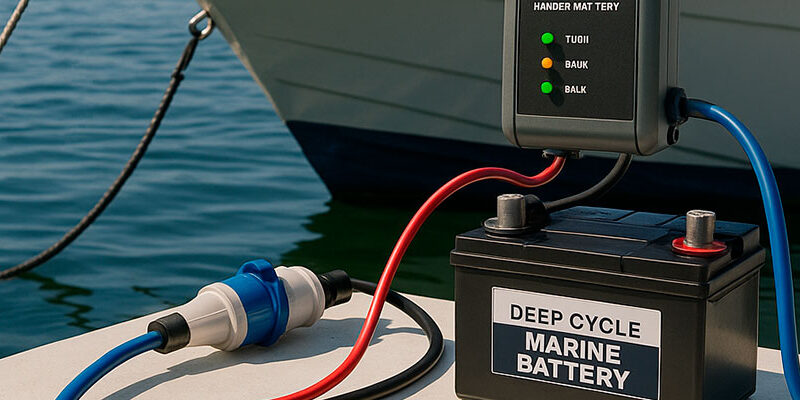
Yes, most modern boat motors do charge batteries. Both outboard and inboard engines include built-in charging systems that replenish your onboard batteries while the engine runs. Understanding how these systems work helps you size your battery bank correctly, avoid dead batteries on the water, and extend overall battery life.
How Boat Motors Charge Batteries
Boat motors generate electrical power through one of two common systems:
-
Stator with rectifier-regulator (typical on small to mid-size outboards). A spinning flywheel induces alternating current, which is converted to direct current and regulated to the appropriate charging voltage for a 12 V or 24 V system.
-
Belt-driven alternator (typical on inboards and larger outboards). The alternator produces DC power and works with an internal or external regulator to maintain proper battery voltage under varying loads.
Outboard Motors
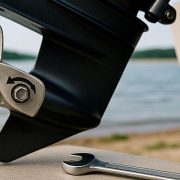
Small outboards often deliver a modest charge suitable for a starting battery and light accessories. Mid-range and large outboards from brands like Yamaha, Mercury, and Suzuki commonly feature higher-output charging systems capable of maintaining both a start battery and a house battery running electronics such as chart plotters, VHF radios, and fish finders. Typical regulated charging voltage with the engine running is about 13.8–14.4 V on 12 V systems.
Inboards and Sterndrives
Inboard gasoline and diesel engines, as well as sterndrives, generally use automotive-style alternators. Depending on the model, outputs can range widely, supporting greater loads like refrigeration, bow thrusters, and lighting on cruising boats. Many yachts upgrade to high-output alternators with smart external regulators to optimize charging for deep-cycle banks.
Charging Multiple Batteries on a Boat
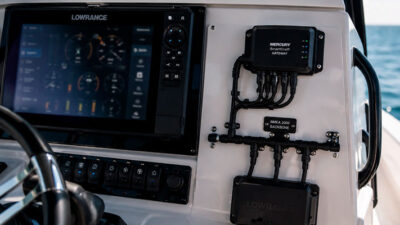
Many boats use separate banks: a dedicated starter battery and one or more deep-cycle house batteries. To ensure safe, efficient charging and isolation, consider the following components:
-
Automatic charging relay (ACR) or voltage-sensitive relay (VSR) to combine banks automatically when charging voltage is present and isolate them when the engine is off.
-
Battery isolator (diode or MOSFET) to feed multiple banks from one alternator without backflow.
-
Dual battery switch with clearly labeled positions for selecting bank 1, bank 2, or both.
-
DC-to-DC charger for boats with smart alternators or mixed chemistries (for example, a start lead-acid battery and a house lithium battery).
How to Tell if Your Motor Is Charging the Battery
-
Measure resting voltage with the engine off. A fully charged 12 V battery typically reads about 12.6–12.8 V.
-
Start the engine and measure again at the battery terminals. A healthy charging system usually reads about 13.8–14.4 V on lead-acid; lithium may hold a steady regulated value depending on the battery management system.
-
Check the owner’s manual for your outboard or inboard engine to confirm charging output and regulator type.
-
Verify indicator lights or charging icons on your helm display if equipped.
Maintenance Tips for Reliable Charging
-
Inspect and clean battery terminals, lugs, and bus bars; apply dielectric protection where appropriate.
-
Check alternator belts for correct tension and wear; replace glazing or cracked belts.
-
Confirm all negative returns are on a common ground bus to prevent stray current issues.
-
Test the rectifier-regulator or voltage regulator if voltage is too low or too high.
-
Secure cabling against vibration and chafe; use marine-grade tinned wire and heat-shrink terminals.
When to Add a Shore Power Marine Battery Charger
While boat motors charge batteries underway, long periods at the dock or at anchor still benefit from a shore-power charger. A modern multi-stage marine battery charger maintains float voltage, prevents sulfation in lead-acid batteries, and keeps house loads supported without cycling the engine. For boats with significant hotel loads, consider pairing the engine’s charging system with a smart charger or an inverter-charger.
Lithium and Mixed-Chemistry Considerations
Lithium iron phosphate (LiFePO4) house banks demand proper voltage limits and current control. Many skippers use a DC-to-DC charger between the start battery (charged by the alternator or outboard stator) and the lithium bank. This protects the alternator from sustained high output, ensures correct charging profiles, and isolates the start battery for engine reliability.
Typical Charging Outputs and Expectations
-
Small outboards: light charging suitable for maintaining a starting battery and minimal electronics.
-
Mid-size to large outboards: moderate to high charging output capable of supporting a start battery plus a modest house bank.
-
Inboards and sterndrives: alternator-based systems with higher continuous output; often paired with smart regulation for deep-cycle banks.
Safety and Best Practices
-
Fuse battery positive leads close to the battery to protect against short circuits.
-
Use proper ventilation around lead-acid batteries to dissipate hydrogen gas.
-
Mount chargers and regulators away from heat and spray; follow IP ratings and manufacturer guidelines.
-
Label battery banks, switches, and emergency combine procedures at the helm.
Frequently Asked Questions
Do all boat motors charge batteries? Most modern outboard and inboard motors provide charging while running, but the output varies by model. Check your engine specifications.
Can one engine charge two or more batteries? Yes, with an ACR, VSR, isolator, or DC-to-DC charger to manage multiple banks safely.
Is the engine’s charging system enough for heavy house loads? It depends on alternator or stator capacity. Cruising boats with refrigerators, inverters, and lighting often add shore chargers, solar, or alternator upgrades.
What voltage should I see while charging? On a 12 V lead-acid system, expect roughly 13.8–14.4 V at the battery with the engine running, measured by a quality voltmeter.
Conclusion
Boat motors do charge batteries, and this built-in capability is central to reliable onboard power. Outboard stator systems and inboard alternators keep your start and house banks energized while underway, especially when paired with proper battery management hardware. For the best results and longer battery life, supplement engine charging with a shore power marine battery charger, consider DC-to-DC solutions for mixed chemistries, and maintain your wiring and connections to marine standards.