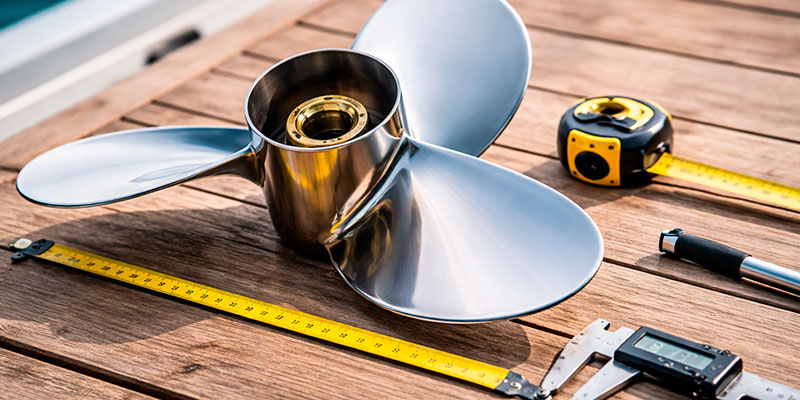
Knowing how to measure a boat propeller is essential for correct replacement, better performance, and safe operation on the water. Whether you are maintaining pleasure craft, upgrading yacht equipment, or searching for boats spare parts, understanding propeller dimensions helps you choose the right component for your vessel. A properly sized propeller improves fuel efficiency, engine performance, and handling, while the wrong one can cause vibration, overload, and poor acceleration.
Main dimensions of a boat propeller
When people ask how do you measure a boat propeller, they usually refer to two main specifications: diameter and pitch. These are the primary values used to identify most marine propellers.
The diameter is the distance across the imaginary circle created by the blade tips during rotation. The pitch is the theoretical distance the propeller would move forward in one full turn without slippage. For example, if a propeller is marked 14 x 19, it usually means 14 inches in diameter and 19 inches in pitch.
These specifications are often stamped directly on the hub. Before manually measuring anything, inspect the propeller carefully. In many cases, the manufacturer has already provided the information you need, which makes sourcing boats spare parts much easier.
How to measure propeller diameter
The diameter is one of the easiest dimensions to determine. To measure it manually, start at the center of the hub and measure straight to the tip of one blade. Then multiply that figure by two. The result is the total diameter of the propeller.
This step is important when replacing worn or damaged yacht equipment because even a slight difference in diameter can affect engine load and overall performance. A larger diameter generally moves more water, while a smaller diameter may allow higher engine speed depending on the setup.
How to measure propeller pitch
Pitch is more difficult to measure precisely without special tools. If you want to understand how do you measure a boat propeller correctly, you should know that pitch is based on the angle and shape of the blades. Marine workshops often use pitch blocks, gauges, or digital measuring systems to determine it accurately.
For practical purposes, boat owners usually rely on the stamped pitch number or manufacturer documentation. This is especially useful when ordering boats spare parts online or comparing compatible replacement options. If the pitch is unknown and markings are missing, a propeller repair shop can usually inspect and identify it professionally.
How to identify propeller rotation
Another important detail is the direction of rotation. A propeller may be right-hand or left-hand. This matters because installing the wrong rotation will make the propeller incompatible with the drive system.
To identify rotation, look at the blades from the rear of the propeller. If the blades slope upward to the right, it is typically a right-hand propeller. If they slope upward to the left, it is generally a left-hand propeller. This is especially important in twin-engine applications and advanced yacht equipment systems where each side may require a specific rotation.
Blade count and its role
When measuring and selecting a propeller, you should also count the number of blades. Most recreational boats use three-blade or four-blade propellers. Three-blade designs are commonly chosen for higher top speed, while four-blade versions often provide better acceleration, grip, and smoother handling.
Although blade count is not a measurement in the strict sense, it is a critical identification factor when ordering boats spare parts. Changing the number of blades can alter the boat’s performance characteristics, so it should be done with care.
Measuring the hub and shaft connection
If you are replacing a propeller, you also need to measure the hub and shaft connection. A propeller is not defined only by diameter and pitch. It must also match the shaft diameter, spline count, and hub design of the engine or drive system.
For outboard and sterndrive applications, count the splines and verify the hub kit type. For shaft-driven boats, measure the internal bore and keyway dimensions. This part of the process is especially important when working with yacht equipment, because compatibility issues often arise from the hub rather than the blades themselves.
Check for markings and manufacturer codes
One of the best ways to simplify the process is to check the propeller for stamped numbers, part codes, or brand markings. Many manufacturers place essential data on the barrel or hub, including diameter, pitch, rotation, and model series. This information can save time and reduce errors when searching for boats spare parts.
If the markings are damaged or unreadable, compare the old propeller with manufacturer catalogs or ask a marine parts supplier to match it using dimensions and photos. Accurate identification is always better than guessing, especially when dealing with performance-sensitive yacht equipment.
Why correct propeller measurement matters
Understanding how do you measure a boat propeller is not just a technical exercise. It directly affects how the boat performs. A propeller with too much pitch can overload the engine and reduce RPM. A propeller with too little pitch may allow the engine to over-rev and reduce efficiency. Incorrect diameter or hub dimensions can cause vibration, cavitation, and installation problems.
For this reason, accurate propeller measurement is a basic but essential part of marine maintenance. It helps boat owners, mechanics, and marine suppliers select the correct boats spare parts and maintain reliable yacht equipment in all operating conditions.
Conclusion
If you want to know how do you measure a boat propeller, start with the basics: diameter, pitch, rotation, blade count, and hub dimensions. Always check for stamped markings first, then confirm measurements manually if needed. Whether you are servicing a small motorboat or managing professional yacht equipment, correct propeller identification is the key to performance, safety, and long-term reliability. Accurate measurements make it easier to choose the right boats spare parts and keep your vessel operating at its best.