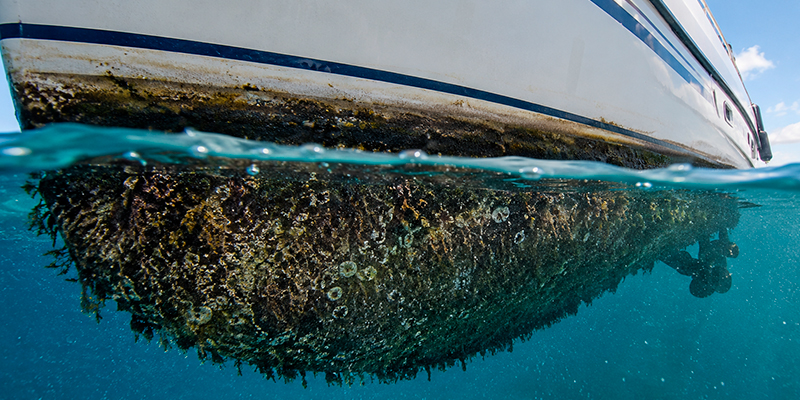
Marine growth is a constant challenge for boat and yacht owners. Algae, biofilm and other organisms can gradually accumulate on the hull and underwater equipment, increasing drag and creating additional maintenance work. Traditional antifouling coatings remain widely used, but another technology has become increasingly popular: the ultrasonic antifouling system.
So, how does ultrasonic antifouling work, and what makes it different from conventional boat antifouling methods? Instead of applying a chemical coating to the underwater surface, ultrasonic antifouling uses high-frequency vibrations transmitted through the hull to make it more difficult for marine organisms to establish themselves.
What Is Ultrasonic Antifouling?
Ultrasonic antifouling is an electronic method of protecting boat hulls and underwater components against biofouling. A typical system consists of a control unit connected to one or more ultrasonic transducers installed inside the vessel.
The controller generates electrical signals that are converted by the transducers into high-frequency mechanical vibrations. These vibrations travel through the hull material and create conditions at the hull-water boundary that interfere with the early stages of marine growth.
Unlike conventional antifouling paint, the technology does not depend on releasing active chemicals from a coating into the surrounding water. The system instead operates continuously while supplied with electrical power.
How Does an Ultrasonic Antifouling System Work?
The basic operating principle can be divided into several stages.
1. The Controller Generates an Ultrasonic Signal
The control module supplies the ultrasonic transducers with specially generated electrical signals. Many modern systems do not operate at just one fixed frequency. Instead, they use a range of ultrasonic frequencies or a frequency-sweeping algorithm.
Using multiple frequencies helps distribute ultrasonic activity across the protected structure and reduces dependence on a single resonant frequency.
2. Transducers Convert the Signal into Vibrations
Ultrasonic transducers are bonded directly to the inside surface of the hull. They convert the electrical signal from the controller into mechanical vibrations at ultrasonic frequencies.
Because the transducers are normally installed internally, installation does not necessarily require holes to be drilled through the hull. Correct positioning and solid contact between the transducer and hull surface are important because the ultrasonic energy must transfer efficiently into the structure.
3. Ultrasonic Energy Travels Through the Hull
The hull acts as the medium through which the ultrasonic vibrations propagate. Depending on the system configuration and installation, the technology can be used not only for hull protection but also for areas such as drives, rudders and other underwater structures.
Larger vessels generally require more transducers so that sufficient ultrasonic coverage can be distributed throughout a greater hull area.
4. Biofouling Is Disrupted Before Heavy Growth Develops
Marine fouling normally begins long before barnacles or heavy algae become visible. One of the earliest stages is the development of a microscopic biological layer known as biofilm.
Ultrasonic antifouling technology is intended to interfere with the ability of microorganisms to attach and establish this initial layer. By making the surface less favorable for early-stage biofouling, the system helps reduce the conditions that allow more substantial marine growth to develop later.
What Components Does an Ultrasonic Antifouling System Use?
Although exact configurations vary between manufacturers and vessel sizes, a marine ultrasonic antifouling system normally contains several main components.
- Electronic control module
- One or more ultrasonic transducers
- Power cable
- Signal cables connecting the controller and transducers
- Adhesive or epoxy for mounting the transducers
- Extension cables where greater installation distances are required
The number of transducers is particularly important. A small boat may require only one or two units, while larger yachts can require systems with considerably more transducers positioned throughout the vessel.
Where Are Ultrasonic Transducers Installed?
Marine ultrasonic transducers are typically mounted on the inside of the hull rather than exposed directly to seawater. They are bonded firmly to the hull so the ultrasonic vibrations can transfer from the transducer into the hull structure.
This internal installation has an important practical advantage: many systems can be fitted without adding new thru-hull penetrations.
Transducer placement depends on hull dimensions, construction and the underwater areas requiring protection. Multiple transducers can be distributed along the vessel to provide broader coverage.
What Parts of a Boat Can Ultrasonic Antifouling Protect?
Although hull protection is the most common application, ultrasonic antifouling systems can also be configured to help protect other underwater components.
- Boat and yacht hulls
- Stern drives
- Rudders
- Stabilizers
- Sail drives
- Other suitable underwater structures connected to the protected system
This can be particularly useful for components with complex shapes that may be difficult to keep clean using conventional antifouling methods alone.
Does Ultrasonic Antifouling Replace Antifouling Paint?
Ultrasonic antifouling and antifouling paint work in fundamentally different ways, so they should not automatically be viewed as interchangeable solutions.
Traditional marine antifouling coatings create a protective surface treatment and, depending on the formulation, may release active ingredients or use other surface properties to discourage marine growth. An ultrasonic antifouling system works electronically by transmitting high-frequency vibrations through the vessel structure.
For this reason, ultrasonic technology may be used as part of a broader hull maintenance and antifouling strategy. The most appropriate approach depends on the vessel, operating environment, hull construction, usage pattern and local fouling conditions.
Advantages of Ultrasonic Antifouling
One reason ultrasonic antifouling for boats has attracted attention is that the technology offers several practical advantages.
No Chemical Release from the Ultrasonic System
The ultrasonic process itself does not rely on biocides or other antifouling chemicals being released into the water. This makes it an interesting option for owners looking for a chemical-free antifouling technology.
Continuous Protection
Once installed and powered, an ultrasonic antifouling system can operate continuously. This allows the system to act during the early stages of biofouling rather than waiting until visible marine growth has already developed.
No External Moving Parts
The transducers are normally installed inside the hull. There are therefore no external moving mechanisms required for the basic ultrasonic process.
Protection for Difficult Areas
Ultrasonic energy can be applied to areas such as drives and rudders that may otherwise require additional cleaning and antifouling attention.
Potentially Reduced Hull Cleaning
By limiting marine growth, an effective system can help reduce the amount of fouling that must later be removed manually. Actual cleaning requirements will still depend on vessel operation and environmental conditions.
Why a Clean Hull Matters
Biofouling is more than a cosmetic problem. As marine growth accumulates, the underwater surface becomes increasingly rough. This can increase hydrodynamic resistance as the boat moves through the water.
Maintaining a cleaner hull therefore supports efficient vessel operation while also reducing the amount of physical cleaning required during regular maintenance.
Rudders, drives, stabilizers and other appendages can also be affected by marine growth, making comprehensive underwater protection valuable on both recreational boats and larger yachts.
How Many Ultrasonic Transducers Does a Boat Need?
There is no universal transducer count suitable for every vessel. Required coverage depends on factors such as hull length, hull configuration and which underwater components need protection.
Manufacturers therefore offer systems with different numbers of transducers. For example, specialist marine manufacturer BPS Marine produces ultrasonic antifouling systems ranging from smaller multi-transducer configurations for boats to larger PRO systems intended for yachts and larger vessels.
Choosing a correctly sized system is important because ultrasonic energy must be distributed effectively throughout the areas that require protection.
Does Ultrasonic Antifouling Need to Run Continuously?
Ultrasonic antifouling is generally intended for continuous operation while the vessel is in the water. Biofilm and microorganisms can begin attaching whenever suitable conditions exist, so maintaining ultrasonic activity helps provide ongoing protection rather than intermittent treatment.
Power consumption varies according to the controller and number of transducers, making electrical specifications an important consideration when selecting a system for a particular boat.
Is Ultrasonic Antifouling Safe for the Hull?
Marine ultrasonic antifouling systems use microscopic high-frequency vibrations rather than large mechanical movements. Systems designed specifically for marine installation are intended to transmit ultrasonic energy through suitable hull structures without physically moving or penetrating the hull.
However, installation instructions and hull compatibility specified by the system manufacturer should always be followed. Correct bonding of the transducers and suitable positioning are essential for both performance and proper installation.
Ultrasonic Antifouling vs Traditional Antifouling
| Feature | Ultrasonic Antifouling | Traditional Antifouling Paint |
|---|---|---|
| Operating Principle | High-frequency vibrations transmitted through the hull | Protective coating applied to underwater surfaces |
| Installation Location | Transducers typically installed inside the hull | Applied externally to the hull |
| Power Required | Yes | No electrical power required |
| Continuous Operation | Designed to operate continuously | Protection provided by the coating while immersed |
| Thru-Hull Installation | Not normally required for internally bonded systems | Not applicable |
| Main Objective | Interfere with early-stage biofouling and attachment | Discourage marine growth on coated surfaces |
Is Ultrasonic Antifouling Worth Considering?
For boat and yacht owners looking for an alternative or complementary approach to conventional antifouling, ultrasonic technology offers an interesting solution. It works continuously, requires no external moving parts and can provide antifouling protection across hull surfaces and selected underwater components.
The key is choosing a marine ultrasonic antifouling system that is correctly sized for the vessel and installing the transducers according to the manufacturer’s requirements. Hull size, construction, operating conditions and the areas requiring protection should all be considered when selecting a system.
Conclusion
So, how does ultrasonic antifouling work? In simple terms, an electronic controller drives ultrasonic transducers mounted inside the vessel. The transducers generate high-frequency vibrations that travel through the hull and help disrupt the conditions required for microorganisms and biofilm to establish themselves on underwater surfaces.
Rather than relying solely on a coating applied to the outside of the boat, ultrasonic antifouling provides an active, continuously operating form of marine growth protection. For suitable boats and yachts, it can become a useful part of a broader antifouling and hull maintenance strategy.